

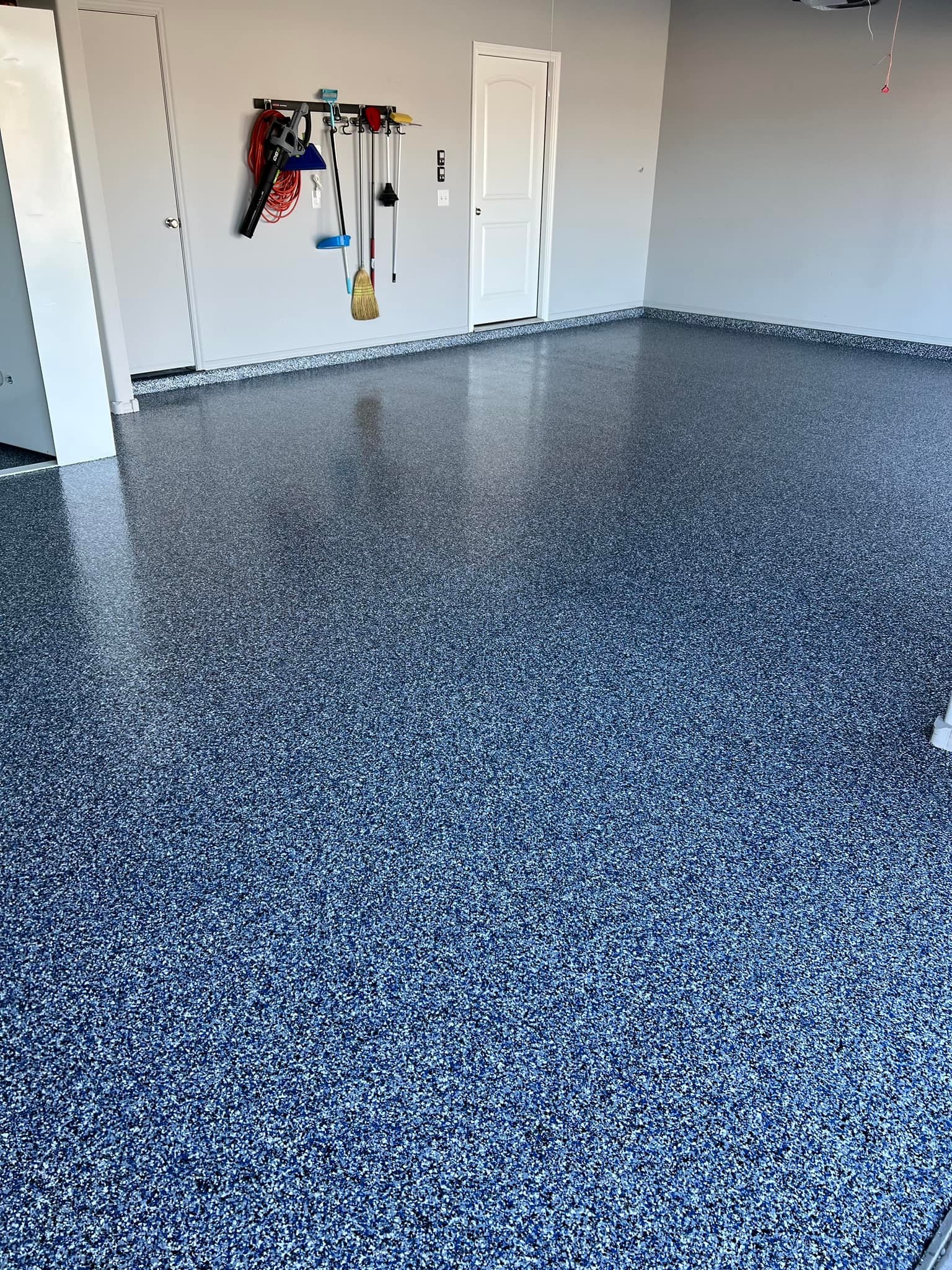
Garage Floor Paint vs. Epoxy: Why Paint Doesn’t Last
Garage floor paint is a thin, inexpensive coating that adds color to concrete, but it usually doesn’t hold up to real garage conditions. It typically peels, chips, and shows tire marks within a year or two, while a professionally installed epoxy or polyaspartic system is built to last many years. If you’re deciding between the two, here’s why paint falls short, where it might still make sense, and what to choose instead.
What’s the Difference?
Garage floor paint is usually a latex or acrylic paint, sometimes sold as “epoxy paint” or “epoxy-acrylic.” It’s a thin film that sits on the surface of the concrete. It’s quick and cheap to apply, which is its main appeal.
Epoxy is a two-part resin that chemically bonds to the concrete and cures into a thick, hard layer. Professional systems are applied over a ground, repaired slab and often include a decorative flake layer and a protective topcoat.
Polyaspartic is a fast-curing polymer coating that goes down in a single day and resists UV yellowing, which is why many professional installers now prefer it. See the garage floor coating options ACES installs.
Why Garage Floor Paint Doesn’t Last
It’s thin. Paint builds a very thin layer, so it wears through quickly under foot traffic, dragged tools, and vehicle tires.
Hot tire pickup. Warm tires can soften paint and pull it off the concrete, leaving ugly marks and bare patches where you park.
Poor adhesion. Paint doesn’t bond into the concrete the way a properly installed resin coating does. Without aggressive preparation, it peels in sheets.
Moisture problems. Moisture vapor rising through the slab pushes paint off from underneath, causing bubbling and flaking. Concrete naturally holds and moves moisture, so a thin film has little defense.
Chemical staining. Oil, brake fluid, gasoline, and road salt can stain or break down paint.
Surface prep is still required. Even for paint, a clean, profiled surface matters. Industry groups like the International Concrete Repair Institute set surface-profile standards because coating performance depends on how well it bonds to the concrete, and the American Concrete Institute publishes broader guidance on concrete best practices. Most DIY paint jobs skip proper grinding, and they fail early as a result.
Side-by-Side Comparison
| Garage Floor Paint | Epoxy | Polyaspartic | |
|---|---|---|---|
| Thickness | Very thin | Thick | Medium to thick |
| Typical lifespan | Often 1 to 3 years | Commonly 10+ years (professional) | Many years, with select systems warrantied |
| Hot tire resistance | Poor | Good with quality products | Excellent |
| Chemical resistance | Low | Good | Excellent |
| UV stability | Fair | Can yellow over time | Resists yellowing |
| Cure time | Hours to a day or two | Days | Hours; vehicles in about 24 hours |
| Upfront cost | Lowest | Moderate | Higher |
Lifespan figures are general estimates and vary with preparation, product quality, and use.
What About the Cost?
Paint is the cheapest option up front, which is why it’s tempting. Epoxy and polyaspartic cost more, and the price depends on your garage’s size, the condition of the slab, and the finish you choose.
The catch is cost over time. If paint needs redoing every year or two, including the work of stripping the failed layer before recoating, the savings disappear quickly. A professional floor installed once is often the better value over the long run. To see what that would look like for your garage, call ACES at 918-850-6898 for a free quote.
When Does Paint Make Sense?
Paint can be a reasonable short-term fix in a few situations:
- A rarely used storage space with no vehicles
- A temporary solution before selling or renting
- A very tight budget where something is better than bare concrete
For a garage that’s actually parked in and used, a real coating system is the better investment.
What to Choose Instead
If you want a floor you only install once, a professional polyaspartic or polyurea system is hard to beat. ACES 24 Hour Floors installs Penntek coatings in a single day, with a floor ready for vehicles in about 24 hours, and select installations come with a lifetime warranty. 0% financing is available for qualifying projects, and every project starts with a free on-site consultation.
Penntek’s formulations are also low-VOC, which matters in attached garages, since the EPA notes that VOCs can affect indoor air quality.
Explore the ACES Product Line
- Premium Penntek Floor Coatings are the long-lasting polyaspartic and polyurea systems we recommend over paint.
- Chip Floor Color Samples & Finishes gives you plenty of color and style options, without the peeling.
- Ashford Formula – Concrete Densifier & Sealer is a clear alternative that hardens and seals bare concrete.
- Retroplate Concrete Polishing delivers a polished concrete floor with no paint or coating to peel.
Frequently Asked Questions
Is garage floor paint the same as epoxy? No. Paint is a thin film. Epoxy is a two-part resin that bonds to the concrete and builds a much thicker, harder layer. Some products labeled “epoxy paint” are mostly paint with a small epoxy content.
How long does garage floor paint last? Often just one to three years in a garage that’s used regularly, and sometimes less where cars park.
Why does garage floor paint peel? Usually from poor surface preparation, moisture coming through the slab, or hot tires lifting the coating.
Can I paint over old garage floor paint? Peeling or failing paint needs to be removed first. New coatings won’t hold well over a weak layer.
Is epoxy worth the extra cost over paint? For a garage that gets daily use, usually yes. A professionally installed system lasts many years longer, which makes the cost over time lower.
Author: Johnny Spriggs